
When your investments are performing well, changing your portfolio may seem unnecessary. Your mutual funds are generating returns, your stocks are gaining value, and your overall investment balance is growing. Naturally, you may want to let things continue as they are.
However, a portfolio that performs well is not necessarily a portfolio that remains aligned with your financial goals.
Over time, different investments generate different returns. Some assets grow faster than others, gradually changing the way your money is distributed across your portfolio. This can increase your exposure to certain risks without you even realising it.
This is where portfolio rebalancing becomes important. It helps you maintain your desired asset allocation, manage investment risk, and keep your portfolio aligned with your long-term financial objectives.
What Is Portfolio Rebalancing?
Portfolio rebalancing is the process of adjusting your investments to bring them back to your intended asset allocation.
Asset allocation refers to how your money is distributed across different investment categories, such as equity, debt, gold, and other assets. The right allocation depends on factors such as your financial goals, investment horizon, income, and risk tolerance.
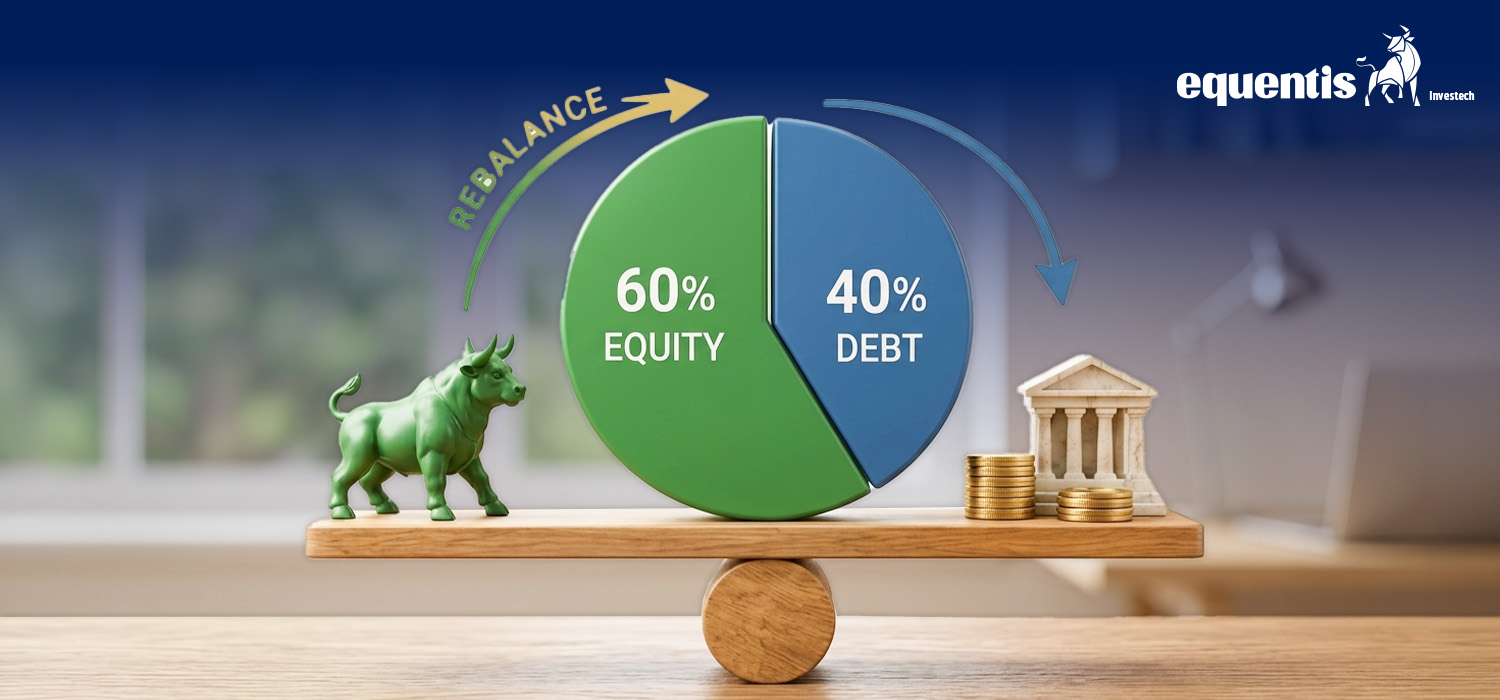
For example, suppose you initially invest ₹10 lakh in a portfolio consisting of 60% equity and 40% debt.
Your investments would be distributed as follows:
- Equity investments: ₹6 lakh
- Debt investments: ₹4 lakh
Now, imagine that equity investments perform significantly better than debt investments over the next year. Your equity allocation increases to ₹7.5 lakh, while your debt allocation remains at ₹4 lakh.
Your total portfolio is now worth ₹11.5 lakh. Equity accounts for approximately 65.2% of the portfolio, while debt accounts for 34.8%.
Although your portfolio has grown, your asset allocation has changed. You are now more exposed to equity market fluctuations than you originally intended.
Rebalancing involves adjusting these proportions to bring them closer to your target allocation of 60% equity and 40% debt.
The objective is not to reduce returns simply because an investment has performed well. It is to ensure that your portfolio continues to reflect the level of risk you are comfortable taking.
Why Should You Rebalance a Portfolio That Is Performing Well?
1. Strong Returns Can Increase Your Investment Risk
One of the biggest reasons to rebalance your portfolio is that strong performance can gradually increase your exposure to risk.
When a particular asset class performs better than others, its share of your portfolio increases. If equity markets experience a strong rally, for instance, equity may begin to dominate a portfolio that was originally designed to balance growth with stability.
This can become a problem when market conditions change.
Suppose you are investing for a financial goal that is only a few years away. A portfolio that has gradually become more equity-heavy could expose you to a significant decline just when you need the money.
Portfolio rebalancing helps prevent this gradual shift in risk. It allows you to maintain an allocation that reflects your financial circumstances rather than simply following the assets that have delivered the highest returns.
2. It Prevents Your Portfolio From Becoming Dependent on One Asset Class
A diversified portfolio spreads investments across different asset classes to reduce dependence on any single source of returns.
However, diversification can weaken over time if one investment category consistently outperforms the others.
For example, a portfolio that initially contains equity, debt, and gold may become heavily concentrated in equity after a prolonged bull market. Even though the portfolio continues to generate positive returns, it may no longer provide the balance you originally planned.
Rebalancing helps restore that balance.
It is important to remember that diversification does not eliminate market risk or guarantee profits. Different assets can also decline together during certain market conditions. Nevertheless, maintaining a suitable allocation can help prevent your portfolio from becoming unintentionally concentrated.
3. It Encourages Disciplined Investing Instead of Emotional Decisions
Investment decisions often become emotional when markets are performing exceptionally well.
Investors may increase their exposure to an asset simply because it has delivered impressive returns. They may also hesitate to sell an investment that has appreciated significantly because they expect it to keep rising.
This behaviour can lead to buying after prices have already increased substantially and taking on more risk than originally planned.
Portfolio rebalancing introduces a more systematic approach.
When an asset class exceeds its target allocation, you review whether some of the gains should be redirected towards underweighted investments. When an asset class falls below its intended allocation, you evaluate whether it makes sense to restore its share.
This approach encourages investors to follow a predetermined strategy instead of reacting to every market movement.
However, rebalancing should not be confused with predicting market movements. An asset that has outperformed may continue to outperform, while an underperforming asset may continue to struggle. The purpose is to maintain your investment strategy, not to forecast which asset will perform best next.
4. It Keeps Your Financial Goals on Track
Your investment portfolio should serve your financial goals, not the other way around.
Consider someone investing for retirement 25 years away. This investor may be comfortable maintaining a relatively high allocation to equity because there is more time to withstand market fluctuations.
Now consider someone planning to purchase a house in three years. The second investor may need a more conservative allocation because a sudden market decline could affect the availability of funds for the purchase.
Even if both portfolios generate strong returns, their rebalancing requirements may differ significantly.
As your goals approach, your financial priorities may change. You may need to reduce exposure to volatile investments, increase the proportion of relatively stable assets, or maintain more money in accessible instruments.
Rebalancing helps ensure that your portfolio evolves alongside your financial needs.
It also provides an opportunity to review whether your original investment strategy still makes sense. Changes in income, family responsibilities, major purchases, and retirement plans can all influence how much investment risk you can reasonably take.
5. It Helps You Maintain a Consistent Risk Profile
Your risk tolerance is not determined solely by how comfortable you feel when markets are rising. It also depends on how much loss you can financially withstand and how you might respond during a market downturn.
A portfolio that becomes increasingly equity-heavy may look attractive during a bull market. However, the same portfolio could feel uncomfortable during a sharp correction.
This difference matters because investment decisions made during periods of market stress can have lasting consequences. Investors who take on more risk than they can tolerate may panic and sell their investments at unfavourable prices.
Rebalancing helps maintain a risk profile that you have deliberately chosen.
It does not prevent losses, but it can reduce the likelihood of unintentionally taking on excessive risk simply because certain investments have performed well.
When Should You Rebalance Your Investment Portfolio?
There is no single rebalancing schedule that works for every investor. The appropriate approach depends on your portfolio, investment strategy, transaction costs, and financial goals.
Three common methods are worth considering.
Time-Based Rebalancing
Under this approach, you review your portfolio at regular intervals, such as every six months or once a year.
A scheduled review makes it easier to monitor asset allocation without constantly reacting to daily market movements.
For long-term investors, an annual review may provide a practical starting point. However, the ideal frequency depends on individual circumstances, and reviewing your portfolio does not necessarily mean you must make changes every time.
Threshold-Based Rebalancing
Under this method, you rebalance when an asset class moves beyond a predetermined limit.
For example, if your target equity allocation is 60%, you might decide to review the portfolio if equity rises above 65% or falls below 55%.
These thresholds are illustrative, not universal recommendations. The appropriate limits depend on your chosen allocation and how much deviation you are willing to accept.
This method helps investors respond to meaningful changes in portfolio risk rather than making unnecessary adjustments whenever asset prices fluctuate.
Cash-Flow-Based Rebalancing
You do not always need to sell investments to rebalance your portfolio.
If you are investing through a Systematic Investment Plan (SIP), receiving a bonus, or adding money to your portfolio regularly, you can direct new investments towards asset classes that have fallen below their target allocation.
For example, if equity has grown beyond its intended share while debt is underweighted, you could allocate new contributions towards debt investments instead of selling equity immediately.
This approach may reduce transaction costs and potential tax implications, depending on the investments involved.
What Should You Consider Before Rebalancing?
Although rebalancing is useful, making frequent adjustments without considering the consequences can be counterproductive.
Before changing your portfolio, evaluate the following factors.
Tax implications: Selling appreciated investments may trigger capital gains tax. In India, the tax treatment depends on the investment category, holding period, and applicable tax rules. Review the potential tax liability before selling assets solely to restore your allocation.
Transaction costs: Brokerage charges, exit loads, and other costs can reduce the benefit of frequent portfolio adjustments. These expenses should be considered before executing a rebalance.
Changes in financial goals: Your target allocation should reflect your current circumstances. If your financial goals, investment horizon, or ability to tolerate losses have changed, your portfolio may require a broader review rather than a simple adjustment to its original proportions.
Market conditions: Strong market performance alone is not a reason to abandon your investment strategy. Similarly, a market decline does not automatically mean that you should increase exposure to an asset. Rebalancing decisions should be based on your financial plan and target allocation.
Investment overlap: Holding several mutual funds or stocks does not automatically mean that your portfolio is diversified. Different investments may have substantial exposure to the same companies, sectors, or market factors. Reviewing the underlying holdings can help you understand your actual exposure.
Common Portfolio Rebalancing Mistakes to Avoid
One common mistake is rebalancing too frequently. Constantly adjusting investments in response to minor market movements can increase costs and encourage short-term thinking.
Another mistake is selling every investment that performs well. An investment should not be sold simply because its returns are positive. The decision should depend on whether it has pushed your portfolio away from its intended allocation and whether the investment still fits your strategy.
Investors should also avoid treating rebalancing as a guaranteed way to improve returns. Its primary purpose is risk management and allocation discipline. Depending on market conditions, a portfolio that is rebalanced may underperform one that is left unchanged.
Finally, avoid following a rebalancing strategy without reviewing whether your original allocation remains appropriate. A portfolio designed when you had a long investment horizon may not suit your needs as you approach retirement or another major financial milestone.
Conclusion
Portfolio rebalancing matters even when your investments are performing well because returns alone do not determine whether your portfolio is positioned appropriately for your financial goals.
As markets move, your asset allocation changes. An investment that once represented a reasonable share of your portfolio can gradually become a much larger source of risk. Rebalancing helps restore your intended allocation, maintain diversification, and encourage disciplined decision-making.
The key is to approach rebalancing systematically. Review your asset allocation periodically, consider the tax and transaction costs of making changes, and adjust your investments when necessary to reflect your goals and risk tolerance.
A well-managed portfolio is not necessarily the one that generates the highest returns in every market cycle. It is one that balances growth, risk, and your ability to stay invested over the long term.
Disclaimer: This article is for educational purposes only and should not be considered investment advice. Consult a qualified financial adviser before making investment decisions.


