
When investors talk about building a portfolio, the conversation often starts with one question:
“Which stocks should I buy?”
It is understandable.
Everyone wants to find the next big winner. The stock that can outperform the market. The company that could multiply their money.
But successful investing is rarely just about picking the right stocks.
A much bigger question is:
How is your entire portfolio structured?
This is where asset allocation comes in.
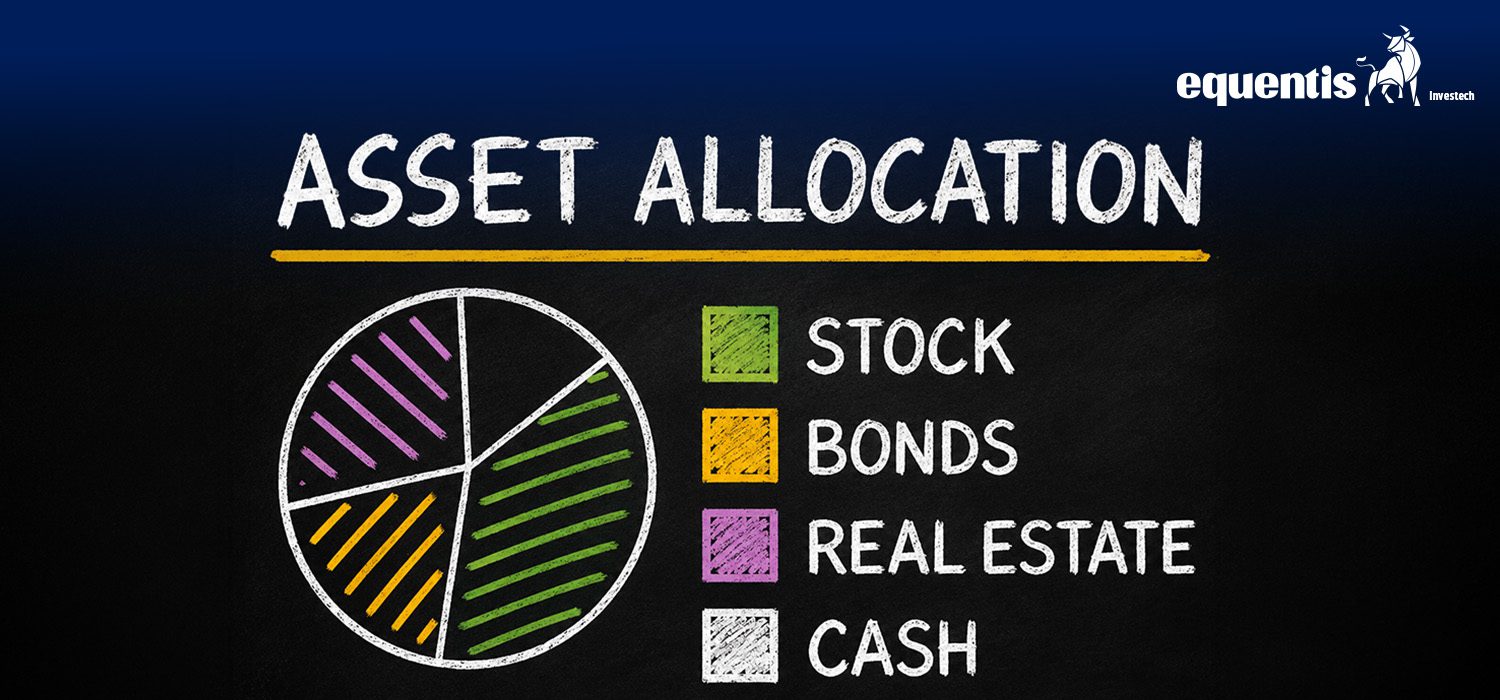
Asset allocation is the process of deciding how much of your portfolio should be invested across different asset classes, such as equities, fixed income, cash and other investments.
While stock selection can influence returns, asset allocation determines how your portfolio behaves as a whole.
And for many long-term investors, that can matter far more.
What Is Asset Allocation?
Simply put, asset allocation means deciding where your money should be invested.
For example, an investor might have:
- 60% in equities
- 30% in fixed-income investments
- 10% in cash or liquid assets
Another investor may choose 40% equities, 50% fixed income and 10% cash.
Neither allocation is automatically better.
The right allocation depends on the investor’s goals, time horizon, financial situation and ability to handle risk.
The key idea is that your portfolio shouldn’t be built by looking at individual investments in isolation.
Every investment should have a role within the larger portfolio.
Why Does Asset Allocation Matter?
Imagine two investors.
Both invest in the same stock.
The stock falls 25%.
For Investor A, that stock represents 10% of the portfolio.
For Investor B, it represents 70%.
They own exactly the same stock.
But their financial experience is completely different.
This illustrates why portfolio structure matters.
Asset allocation can help determine how much impact a single investment, sector or market event can have on your overall wealth.
A well-designed allocation can also help balance growth opportunities with stability.
Asset Allocation vs Stock Picking
Stock picking focuses on one question:
“Which company should I invest in?”
Asset allocation asks a broader question:
“How should my entire portfolio be positioned?”
You could select excellent companies and still have a poorly constructed portfolio.
For example, owning ten technology stocks may look diversified because there are ten different companies.
But if the entire portfolio depends heavily on the same sector, the investor still carries significant concentration risk.
Asset allocation looks beyond individual securities.
It considers how different assets work together.
The Major Asset Classes
Different asset classes behave differently under different market conditions.
Understanding their roles can help investors build a more balanced portfolio.
1. Equities: The Growth Engine
Equities can provide significant long-term growth potential.
Businesses can expand, generate higher profits and increase shareholder value over time.
But equity markets can also be volatile.
Prices can fall sharply during corrections, recessions or periods of uncertainty.
This makes equities powerful long-term growth assets, but not necessarily suitable for every financial goal or time horizon.
2. Fixed Income: Adding Stability
Fixed-income investments can play an important role in balancing equity exposure.
Depending on the instrument, they may provide relatively predictable income and lower volatility than equities.
For investors approaching major financial goals, having an appropriate allocation to fixed income can help reduce dependence on equity market performance.
However, fixed income isn’t completely risk-free.
Interest-rate risk, credit risk and inflation can still affect returns.
3. Cash and Liquid Investments
Cash and highly liquid investments provide flexibility.
They can help investors meet short-term expenses without having to sell long-term investments during unfavourable market conditions.
They can also provide a reserve for emergencies or future investment opportunities.
However, holding excessive amounts of cash for long periods can expose investors to inflation risk.
The goal is to maintain enough liquidity without allowing too much long-term capital to remain unproductive.
Your Risk Profile Matters
There is no universal asset allocation that works for everyone.
A 25-year-old investor with a long investment horizon may be able to tolerate greater equity exposure than someone who needs their money within the next three years.
But age alone isn’t enough.
Two investors of the same age can have completely different financial circumstances.
Their income, existing assets, financial responsibilities, goals and ability to withstand losses may all be different.
This is why asset allocation should reflect risk capacity and risk tolerance, not simply a standard formula.
Time Horizon Changes Everything
The same investment can have very different levels of suitability depending on when the money is needed.
Consider two goals.
An investor needs ₹20 lakh for a house purchase next year.
Another investor is investing ₹20 lakh for retirement 25 years from now.
Treating both amounts in exactly the same way may not make sense.
The first investor has a short time horizon and may have limited ability to recover from a major market decline.
The second has considerably more time to handle market fluctuations.
Asset allocation should therefore be connected to the purpose of the money.
Diversification Is Part of the Strategy
Asset allocation and diversification work closely together.
Diversification spreads investments across different sources of risk.
This could mean diversifying across:
- Equities and fixed income
- Sectors
- Companies
- Geographies
- Market capitalisations
- Investment styles
- Other suitable asset classes
The purpose isn’t to own as many investments as possible.
It is to avoid becoming overly dependent on one investment or one economic outcome.
A diversified portfolio won’t eliminate losses.
But it can reduce the damage caused by concentration.
Why Investors Get Asset Allocation Wrong
One common mistake is building a portfolio based on recent performance.
An asset class performs well.
Investors notice.
Money flows into it.
Then another asset class starts outperforming, and investors shift again.
This can turn investing into a constant search for the next winner.
Another mistake is confusing diversification with quantity.
Owning 15 mutual funds doesn’t necessarily mean having a well-diversified portfolio.
There may be significant overlap between them.
Investors can also become too aggressive during bull markets because rising prices make risk feel smaller.
When markets fall, the same investors may discover that their actual risk tolerance was much lower than they thought.
Rebalancing Keeps the Portfolio on Track
Asset allocation isn’t a decision you make once and forget forever.
Markets move.
If equities outperform other assets for several years, their share of the portfolio can become much larger than originally intended.
For example, a portfolio that started with 60% equities could gradually become 75% equities after a strong market rally.
The investor may now be taking considerably more risk without consciously deciding to do so.
Rebalancing helps bring the portfolio back toward its intended allocation.
It is less about predicting markets and more about maintaining discipline.
Don’t Chase the Perfect Allocation
Investors often search for the perfect percentage.
Should it be 60% equity?
70%?
40%?
There is no universally correct answer.
The better question is:
“What allocation gives me a reasonable opportunity to achieve my goals without taking more risk than I can handle?”
A theoretically optimal portfolio is useless if the investor cannot stay invested through difficult periods.
A slightly more conservative portfolio that an investor can stick with may be far more effective over the long term.
Asset Allocation Should Evolve With You
Your financial life doesn’t remain constant.
Your income can change.
Your responsibilities can change.
Your goals can change.
Your investment horizon becomes shorter as you approach major financial milestones.
Your asset allocation should reflect these changes.
This doesn’t mean constantly changing your portfolio every time the market moves.
It means reviewing whether your portfolio still matches your financial reality.
Sometimes the right decision is to make a change.
Sometimes it is to stay exactly where you are.
The Bigger Picture Matters More Than the Next Stock
Stock picking can be useful.
Finding strong businesses and making sensible investment decisions can contribute to portfolio performance.
But focusing exclusively on individual stocks can make investors overlook a much bigger question:
Does the portfolio work as a whole?
A portfolio isn’t simply a collection of investments.
Each investment contributes to the portfolio’s overall risk, return potential, liquidity and diversification.
That’s why asset allocation deserves attention.
The goal isn’t to predict which asset will perform best next year.
The goal is to build a portfolio that can continue working toward your financial goals across different market environments.
Build the Portfolio, Not Just the Investment List
Investing isn’t a competition to find the highest-returning stock.
It is a long-term exercise in balancing opportunity and risk.
Asset allocation provides the framework for doing that.
It helps investors decide how much risk to take, where that risk should come from and how different investments can work together.
Stock picking chooses the players. Asset allocation decides how the team is built.
And while the next winning stock may grab attention, a well-structured portfolio can play a much bigger role in determining whether an investor successfully reaches their long-term financial goals.
Equentis InvestTech takes a long-term approach to wealth creation, helping investors look beyond individual investments and understand how portfolio structure, diversification, risk and financial goals work together.


